


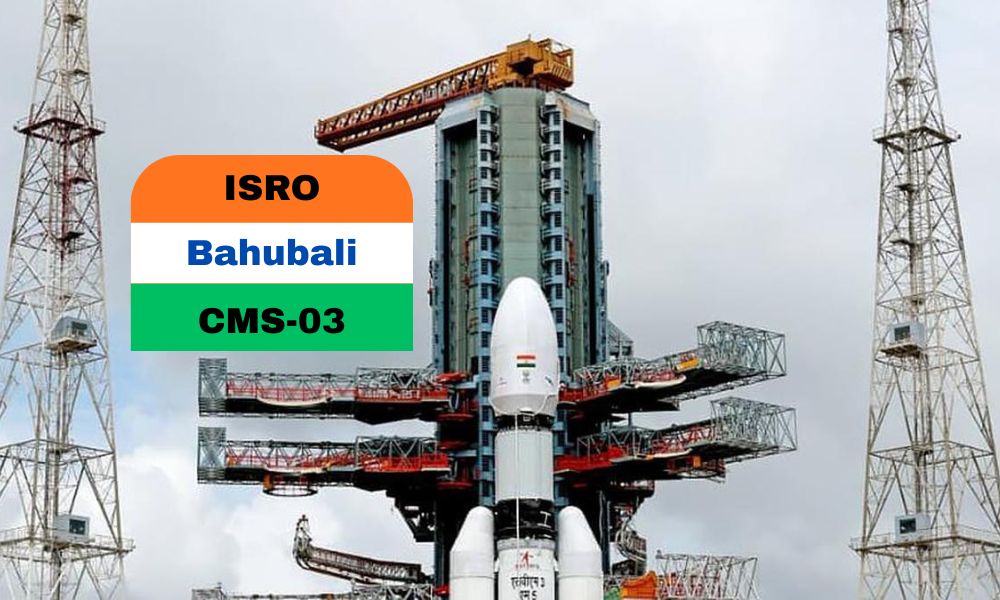
ISRO Bahubali Launch Marks Major Milestone as LVM3-M5 Places 4,410 kg CMS-03 Satellite in Orbit from Sriharikota
ISRO Bahubali Launch: India Achieves Another Space Milestone
In a remarkable achievement for India’s space program, the Indian Space Research Organisation (ISRO) successfully launched its heaviest communication satellite, CMS-03, into orbit on Sunday. The launch took place at 5:26 PM from the Satish Dhawan Space Centre in Sriharikota, Andhra Pradesh, using the LVM3-M5 ‘Bahubali’ rocket — India’s most powerful and entirely homegrown launch vehicle.
The CMS-03 satellite, weighing 4,410 kilograms, is a multi-band communication satellite designed to provide services across a wide oceanic region, including the Indian subcontinent. It was successfully placed into the Geosynchronous Transfer Orbit (GTO), marking a significant leap for ISRO’s indigenous launch capabilities.
ISRO Chairman V. Narayanan confirmed the mission’s success, noting that the LVM3-M5 had “injected the communication satellite into the required orbit flawlessly.” He recalled that the same launch vehicle had earlier carried Chandrayaan-3, which made India proud by successfully landing on the Moon.
Dubbed ‘Bahubali’ for its immense strength and payload capacity, the LVM3-M5 is a three-stage launch vehicle featuring two solid boosters (S200), a liquid core stage (L110), and a cryogenic upper stage (C25). Impressively, all eight LVM3 missions to date — including its experimental flight — have achieved a 100% success rate.
Prime Minister Narendra Modi congratulated ISRO scientists in a post on X (formerly Twitter), praising their relentless innovation and dedication. “Our space sector continues to make us proud… Their successes have furthered national progress and empowered countless lives,” he said.
Union Minister Jitendra Singh also lauded ISRO and the Prime Minister for steering India’s space program toward a golden era of self-reliance and success.
The CMS-03 satellite will serve as a replacement for the GSAT-7 series, launched in 2013, and is expected to remain operational for at least 15 years. Despite facing weather-related challenges, ISRO scientists ensured the mission’s flawless execution.
Earlier, ISRO had relied on Arianespace’s Ariane rockets from French Guiana for launching heavy communication satellites like GSAT-11 (5,854 kg) in 2018. With the LVM3’s success, India now firmly establishes itself as a global contender in heavy satellite launches.
Developed entirely with indigenous technology, including the C25 cryogenic stage, the LVM3 has been instrumental in building India’s capability for future human spaceflight. ISRO confirmed that a human-rated version, named HRLV, will serve as the launch vehicle for the upcoming Gaganyaan Mission.
With the Bahubali rocket’s latest success, ISRO continues to elevate India’s stature in global space exploration, combining innovation, resilience, and national pride in every mission.
Also read: US and India Defence Agreement Marks a New Era of Strategic Cooperation